A few years ago I was working on our latest fixer-upper project which was a small waterfront cabin only a short ferry ride away from Seattle. Transforming a dilapidated waterfront cabin on Vashon Island was no small feat, but the allure of its breathtaking view made it an irresistible challenge. Acquired in foreclosure, the neglected property had become a haven for moisture and local critters. The rehabilitation process demanded an exhaustive overhaul—drywall, floors, doors, windows—every surface had to go. Wiring and plumbing needed to be redone, alongside a laundry list of other repairs. Yet, amidst the laborious restoration, there came a moment of inspiration. As the upstairs took shape, I gazed out at the brooding Seattle sky and the deep indigo waters, and it hit me—this home would reflect the natural beauty outside. Thus, the serene shades of indigo began to weave their way into the interior design, capturing the essence of the Pacific Northwest within.
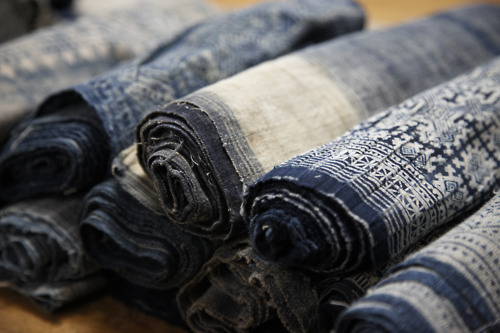
Delving into the origins of indigo revealed a captivating tale. This ancient dye boasts a storied history, and its transformation process is nothing short of fascinating. Unlike most dyes, indigo begins as a vibrant blue, morphs into yellow, then green, before finally oxidizing on the fabric to achieve the iconic deep blue we know and love. For the aficionados, the scientific name of the indigo plant is Indigofera tinctoria—a true gem in the world of natural dyes.
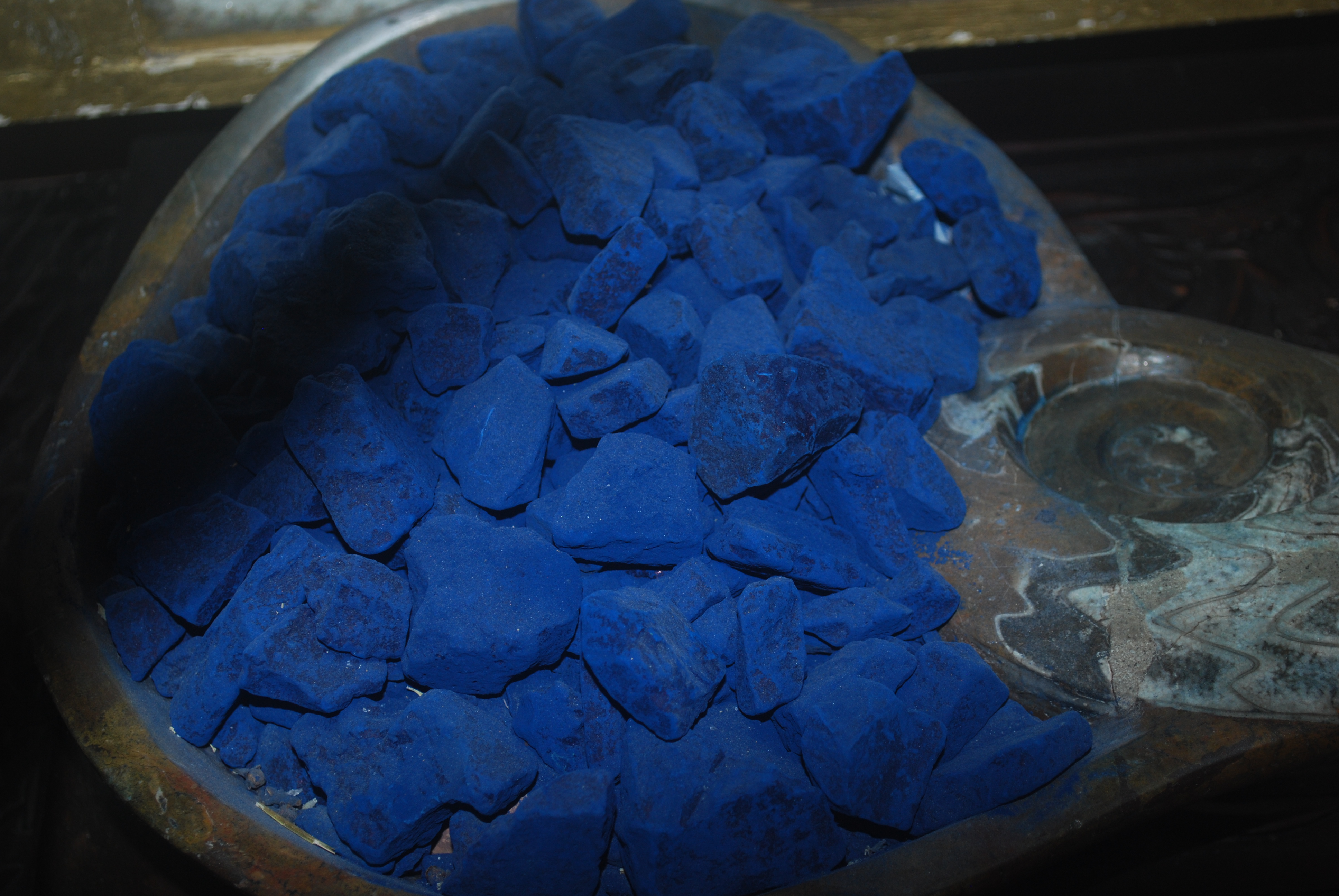
The benefits of cultivating indigo extend beyond its captivating hues; it’s good for both soil and farmer alike. Versatile enough to be grown alongside staples like wheat and corn, indigo’s nitrogen-rich properties rejuvenate the soil, enhancing the yield of food crops. With over 275 plant varieties capable of producing indigo, this dye has naturalized across diverse climates worldwide. No matter the plant, the ancient method of converting leaves into dye remains unchanged. By composting the leaves in alkaline water, the indigo pigment is coaxed out over 12-18 hours, turning the water a deep blue. This blue liquid is then aerated through vigorous beating, causing the dye to settle. The water is drained, leaving behind a bright blue sludge, which is dried and sold in chunks, preserving this age-old craft.
Crafting your own indigo dye is not easy, but thankfully, pioneers like Michele Wipplinger have paved the way. As the visionary founder of Seattle-based Earthues, Michele dedicated her life to demystifying the art of natural dyeing. Though she passed away in 2020, her legacy lives on through her husband Andro and their youngest son Misha, who continue to helm the company. Their spectrum of sophisticated colors is nothing short of extraordinary. You can find Indigo dyeing kits along with many other beautiful natural dyes on their website. https://earthues.com/collections/natural-dyes
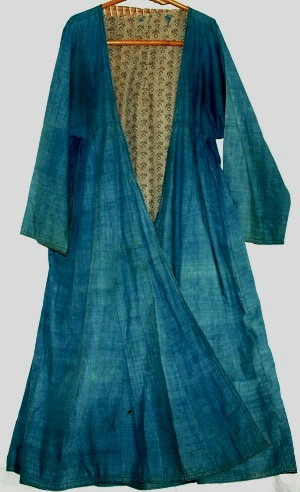
Indigo is often synonymous with deep blue, but it also has a captivating array of hues, including the delicate blue-greens seen in this antique dress from Uzbekistan.
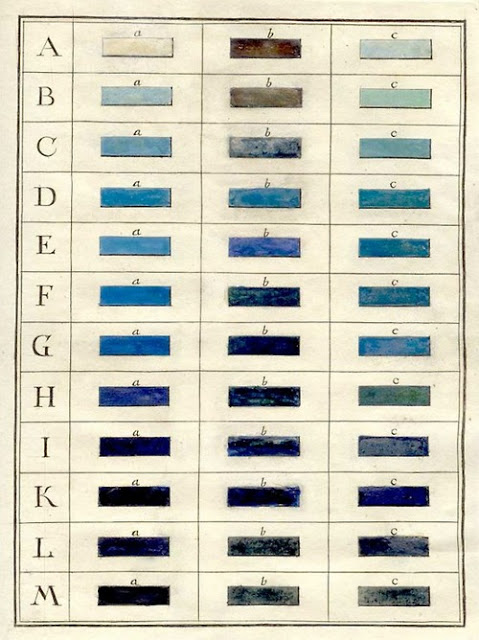
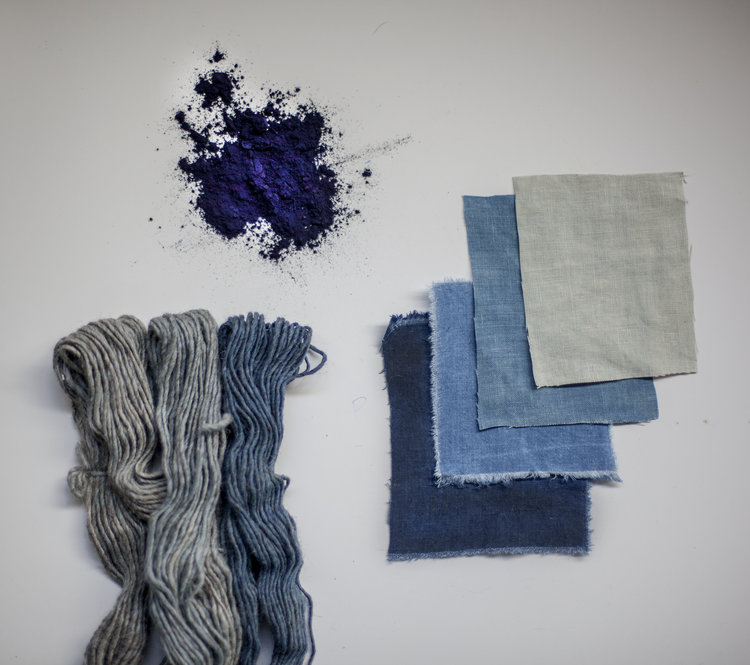
The depth in color is dependent on the concentration of dye in the bath, and how many dips are made into the dye bath with oxidation occurring between each dip. Starting as a light green it then deepens into the deep azure blue that we typically think of as indigo.
The journey of breathing new life into the once-abandoned cabin wasn’t just a feat of construction; it became an odyssey of discovery. My deep dive into the history and science of indigo dye unraveled layers of knowledge I had never anticipated. From the vibrant blues to the subtle blue-greens, the myriad shades of indigo found their way into the heart of our home.
Every room now tells a story of the natural beauty that surrounds us—the walls echo the hues of the Seattle sky, the textiles mirror the serene waters, and even the smallest details carry the essence of indigo’s rich history. This transformation not only revived the cabin but also infused it with a unique charm that celebrates both the past and the present. Indigo, in all its glory, has become the thread that weaves our remodeled cabin into a harmonious tapestry of nature and design.
Images courtesy growingindigo.blogspot.com, national geographic, kahina-givingbeauty.com, naturalmedicinesofnc.com, greenmattersnaturaldyecompany.com
As the temperatures dip this time of year and our homes are covered with snow and ice I started thinking about structures that were made of snow and ice from the inside out. My search lead me to some interesting ice architecture that I thought I would share with you.
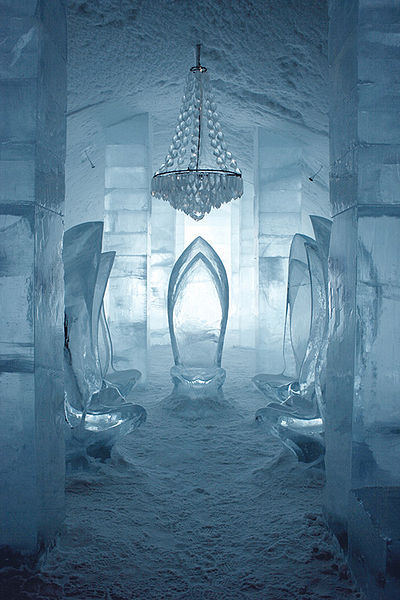
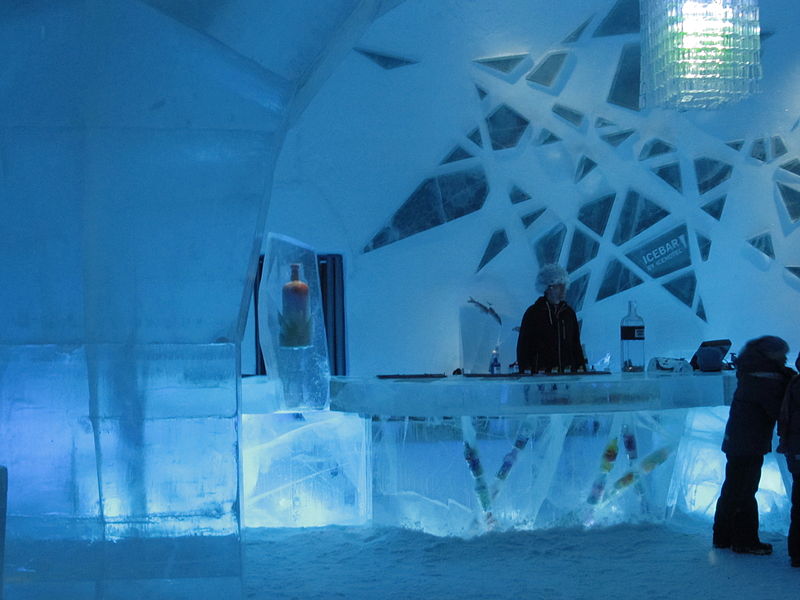
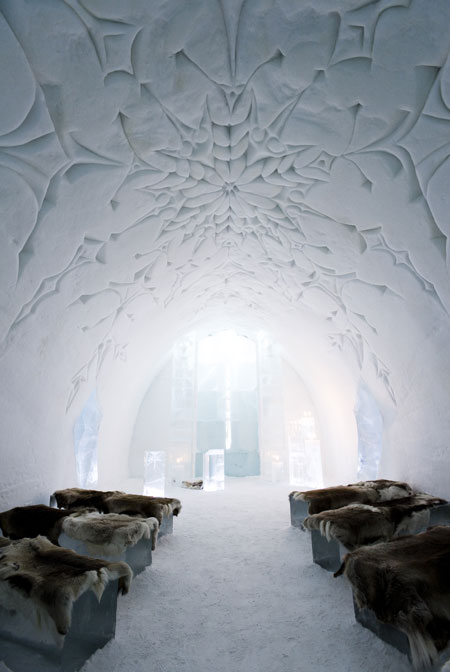
The ICE HOTEL in the village of Jukkasjärvi, about 17 kilometres (11 mi) from Kiruna, in northern Sweden, was the world’s first ice hotel. After its first opening in 1990, the hotel has been erected each year from December to April.
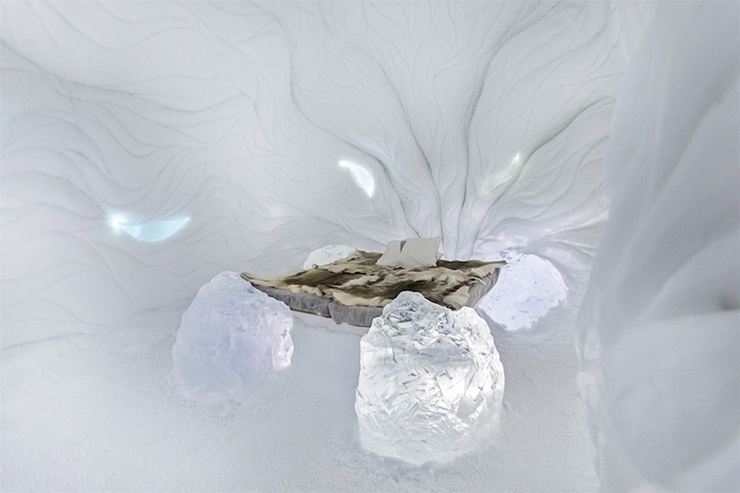
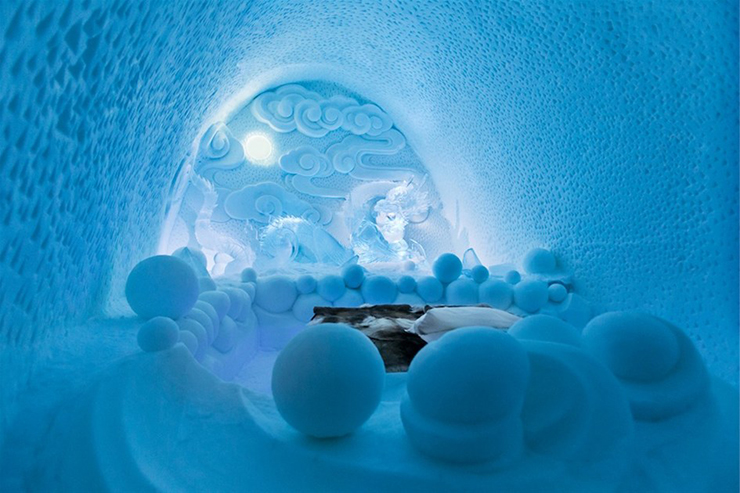
The hotel, including the chairs and beds, is constructed from snow and ice blocks taken from the nearby Torne River. The structure remains below freezing, around 23 °F (−5 °C) which can make staying overnight at the hotel challenging but they have special insulated mattresses, reindeer hides, and down duvets for their guest. Most guest usually stay one night then move to the heated quarters on the grounds.
When completed, the hotel features a bar, church, main hall, reception area, plus rooms and suites for over 100 guests. Each suite is unique and the architecture of the hotel is changed each year since it is rebuilt from scratch. Every year, artists submit their ideas for suites, and a jury selects about 50 artists to create the church, icebar, reception, main hall and suites. When spring comes, everything melts away and returns to the Torne River.
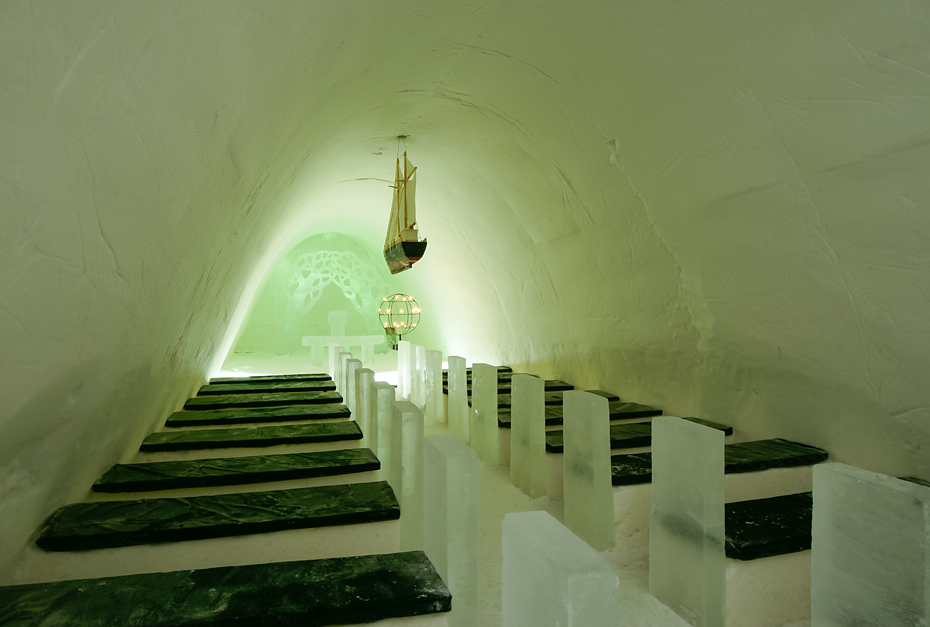
In Finland from December through March the Snowcastle of Kemi is the biggest snow fort in the world. It is rebuilt every winter with a different style of architecture in Kemi, Finland. The area covered by the castle has varied from 13,000 to over 20,000 square metres. The highest towers have been over 20 metres high and longest walls over 1,000 metres long, and the castle has had up to three stories. Despite its varying configurations, the snow castle has a few recurring elements: a chapel, a restaurant and a hotel.
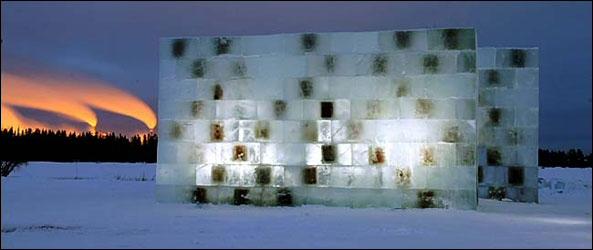
Also in Finland in 2004 was an international project called the The Snow Show. It was a unique artistic collaboration between artists and architects of international renown, a first-of-its-kind exhibition that explored the structures that result when artists and architects experiment with building in snow and ice. The results of this global cultural project were on view in Finland’s Lapland.
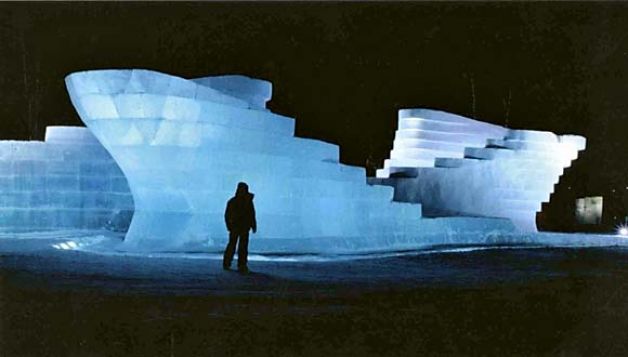
Above is the structure that Zaha Hadid and Cai Guo-Qiang built. Hadid had streamlined blocks of ice that cantilever into the air like the prow of a racing ship. Artist Cai Guo-Qiang then concocted a mix of vodka and ethanol-based gel that, poured onto the twin forms at night, spilling in all directions, creating pools of transient flames.
The above was erected by Morphosis + Do-Ho Suh. The piece was called Fluid fossils. Embedded objects in a constructed archaeology,this project explores the transformation of matter in time.
Above is Penal Colony by Yoko Ono & Arata Isozaki. Ono described the piece with the following piece of poetry.
PENAL COLONY
spring passes
and one remembers one’s innocence
summer passes
and one remembers one’s exuberance
autumn passes
and one remembers one’s reverence
winter passes
and one remembers one’s perseverance
there is a season that never passes
and that is the season of glass
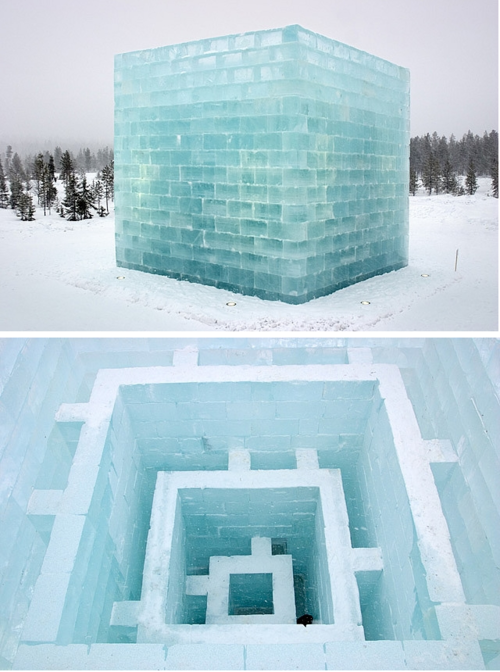
Above we see images of Ice Time Tunnel byTatsuo Miyajima & Tadao Ando. It was described by Ando as follows.
“Using ice, an ephemeral and formless material, I tried to create a minimal and purified form, with a motif of continuous curved line. What emerged in the geometrical space of ice is a sequence of light and air. The abstract concept, sequence, also responds to Tatsuo Miyajima’s artwork, whose theme is time: from past to present and from present to future. The collaboration, ICE TIME TUNNEL has been completed by combining a sequence of my architecture and time and space in Miyajima’s work.”
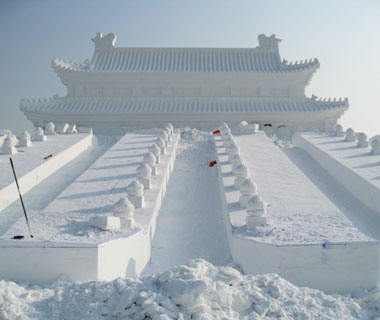
On the another side of the world is the Harbin International Ice and Snow Festival in China’s Heilongjiang province. It lasts for weeks, drawing Chinese and foreign visitors. Nearly 10,000 people were involved in making the sculptures, which are fashioned from huge ice blocks cut from a local frozen river and from blocks of man-made snow. The ice and snow are assembled and sculpted to resemble huge buildings, snow maidens and other structures, some of them lit up fancifully at night as seen above and below.
So while it may be chilly out there, it’s good to see that people around the world are making more than just the best of it. They are creating sculptural and architectural works of art.
“God is in the details” so declared Mies van der Rohe, the famous German born architect and one of the pioneering masters of modern architecture. It’s a phrase often quoted in architecture and design schools. It inspires upcoming talents to consider the smallest decisions. They should make each choice in their projects highly considered.
It’s a good philosophy. Those who have adhered to looking at their work with a discerning eye have given us some truly amazing moments. They not only focus in broad sweeps but also in the smallest of moments. They have excelled in architecture and design.
But when does perfection become the enemy? This became a topic of discussion the other day between myself and another colleague. It came about because he was complaining that another colleague had come through their project that they had recently completed and instead of noticing all that was done with a discerning eye and a high level of skill and execution, they pointed out everything that was wrong. Commenting on all that wasn’t “perfect” in their mind.
As you can imagine this can be quite frustrating. But it is what we, who are in this industry, have been trained to do. We are asked on a daily basis to look at space and objects and put them into a form that is aesthetically pleasing, detailed, and in essence, perfect. We are looking for what is out of place, what is wrong that is creating dissonance in a design. Picking it apart to make it better, always better.
If we are good at what we do, we do indeed make it better but I think its important sometimes to honor that which is already working. To make note of and point out successes, along with that which didn’t succeed.
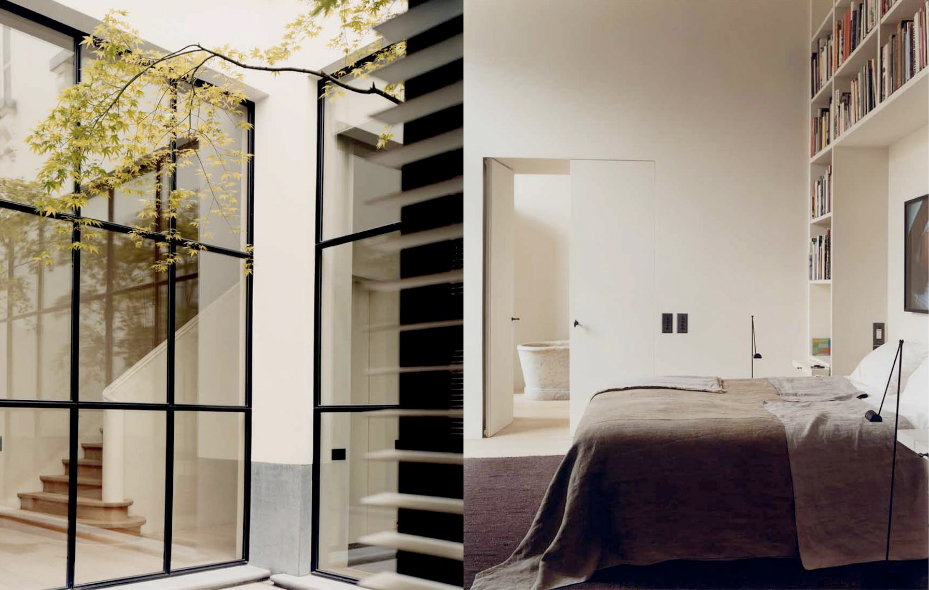
Sometimes what is imperfect is actually what can make it perfect. Just look at what success Axel Vervoordt has had with his work and his base philosophy of WABI SABI. Wabi-sabi is the art of finding beauty in imperfection.
Now granted, he is still very concerned with the details and execution but there is an ethos of honoring that which is unexpected and details that sometimes defy perfection.
With Thanksgiving approaching this has come to the forefront of my mind as the whole spirit of this holiday is about being thankful for what we have. It is not about lamenting over that which we don’t have. Its about honoring the successes, the positives in our lives.
Do I want my work to be perfect? Of course. As my husband will tell you, I will work a detail to death, staying up late into the night to get it just right. However, I’ve set my mind to trying to remember that perfection can be a double edge sword and that I need to be thankful and mindful of all that is good and good enough.
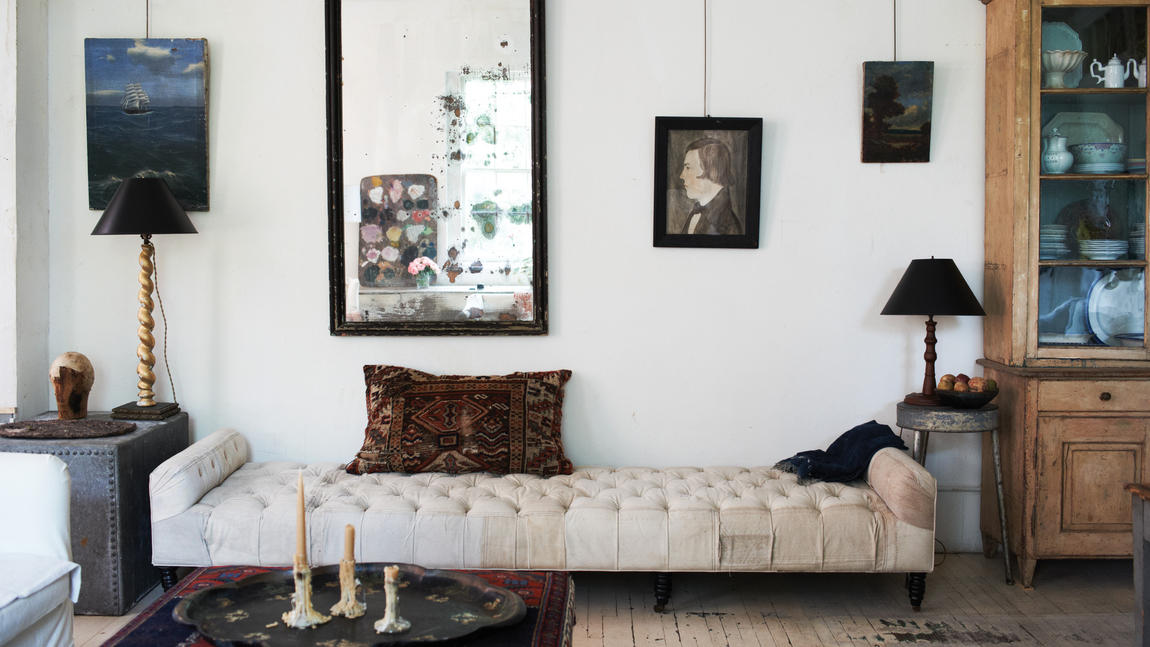
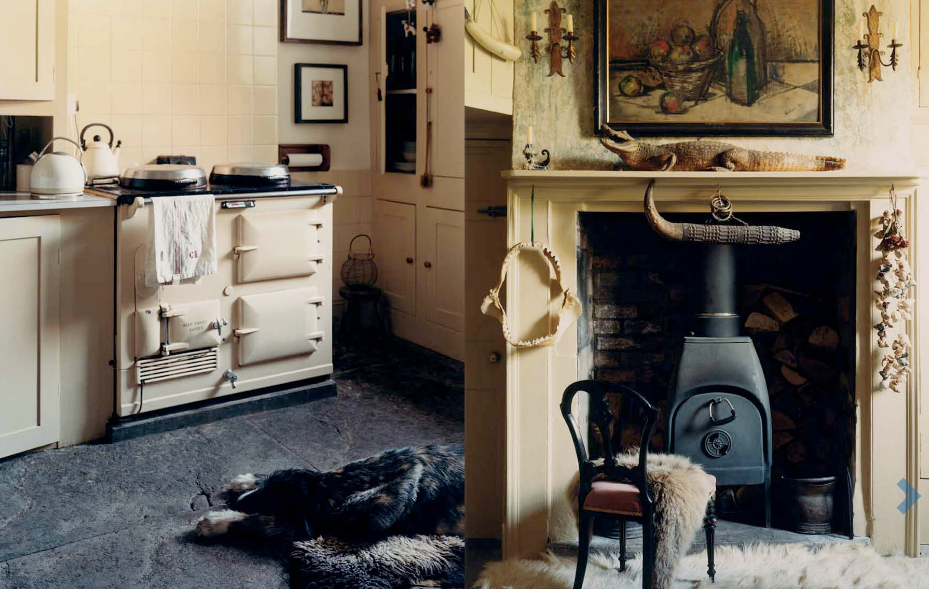
Recently I was thinking about the homes of creatives and how their homes are a true reflection of who they are and the work they do. Some of the more inspiring homes I see in magazines are homes of creative individuals. They have a certain something. An unadulterated vision. Not always perfect but so appealing in their quirkiness. (Above we see the home of John Derian.)
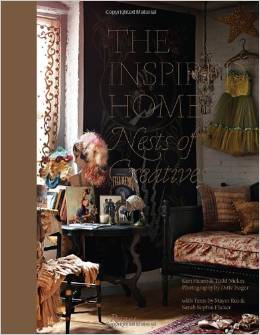
After doing a bit of research I found that Rizzoli published The Inspired Home: Nests of Creatives by Kim Ficaro and Todd Nickey It’s a fresh eye comparing a variety of approaches to living, rather than the depiction of a particular style. The book presents 17 houses belonging to creative people whose quarters reflect their personal and rather inspired approaches to living.
Kim Ficaro is a prop and interiors stylist, and Todd Nickey, is an interior designer and co-owner of Nickey Kehoe, a very cool design shop in Los Angeles and New York City. For this book, they stepped back and used their vision to record the work of others. They used the very talented Ditte Isager to do the photography. Her home is also included in the book.
They discovered a great selection of creative types, from designers and tastemakers to writers and musicians. The homeowners passions, aesthetics, and sensibilities are reflected in their surroundings for us to observe and sometimes take note for their rejection of the norms in “designed” spaces. Some good old fashioned rule breaking never hurt anyone I say. Some great examples below for inspiration.
Hand-painted wallpaper brightens mornings in Allison Shearmur’s Los Angeles home.
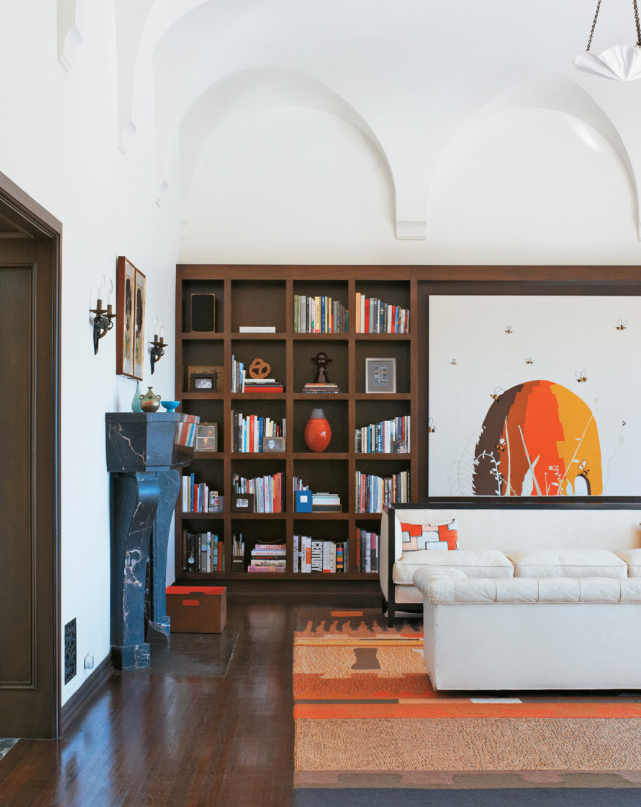
The living room of Shearmur’s home is stately and minimal. The bookshelves contain an amazing array of art books as well as smaller collected pieces.
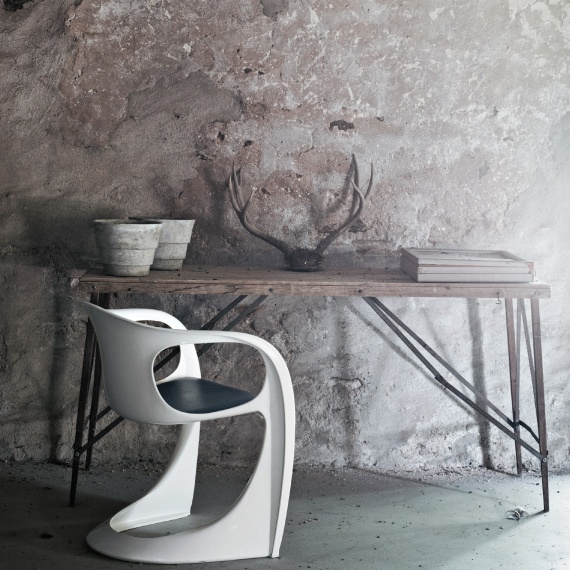
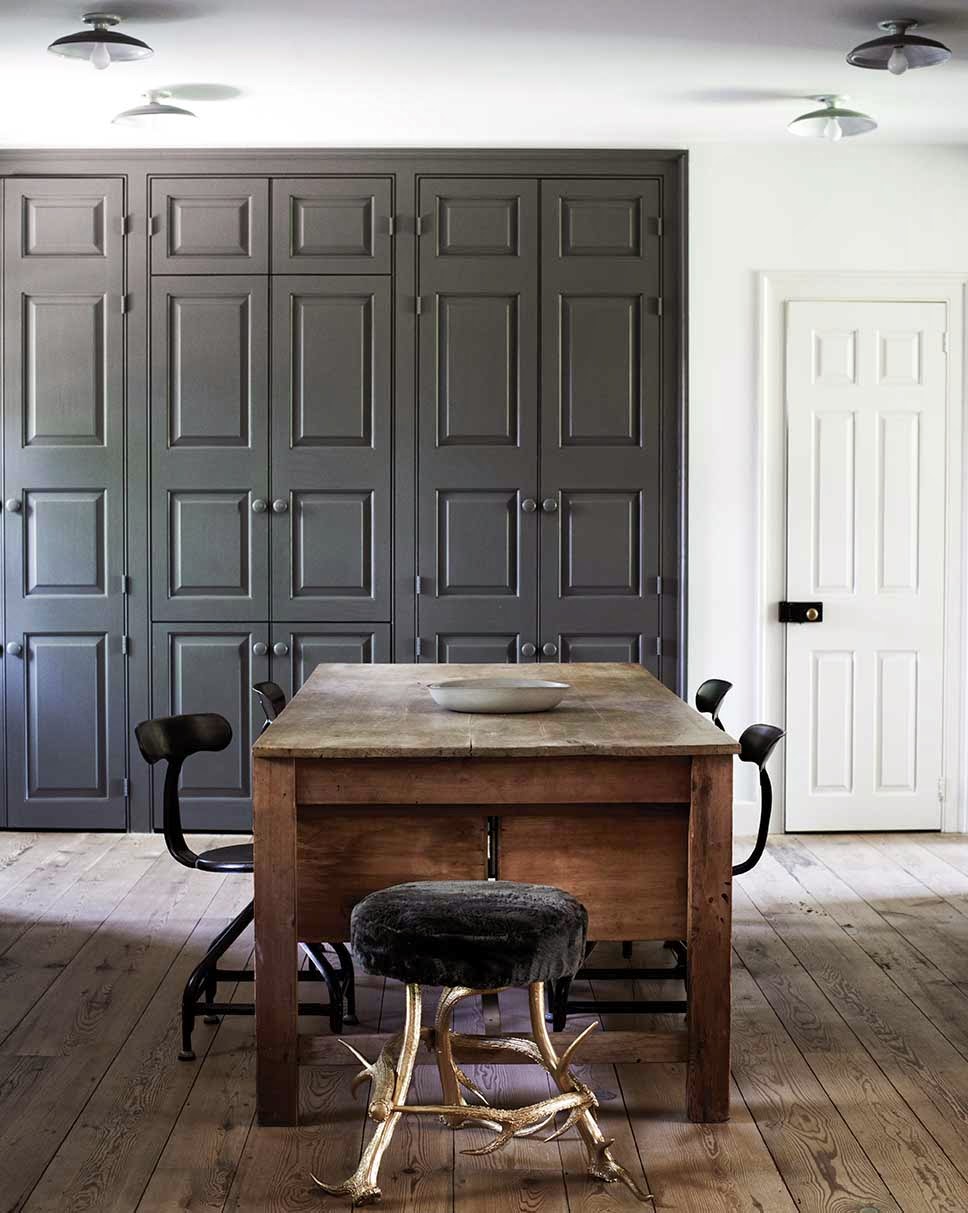
A modern chair sits beside an old wallpapering table in the white-and-gray New Hope, Pennsylvania, home of Richard Ferretti and James Gager.
An artful, orderly array of cabinets adjacent to the kitchen in the Ferretti/Gager home.
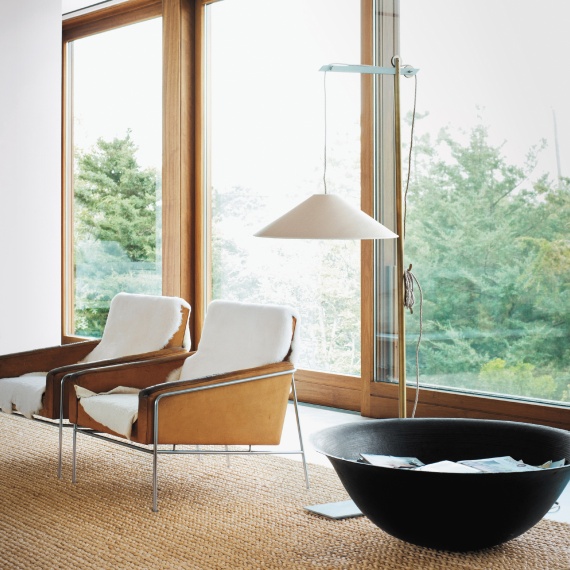
In Doug Lloyd’s Hamptons retreat, floor-to-ceiling sliding doors blur the boundaries between indoors and out.
Martyn is an expat from Australia currently residing in NYC who began his photographic career over 30 years ago starting with shooting his own fashion line. However, his images grabbed more attention than his clothing line and thus he began working for the likes of Architectural Digest, W, Vogue, as well as capturing imagery for Tiffanys, Ralph Lauren, Hermes, and Gucci.
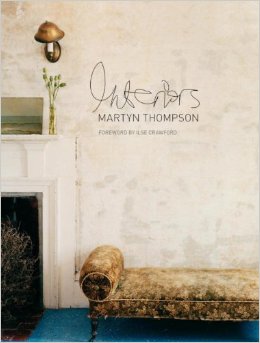
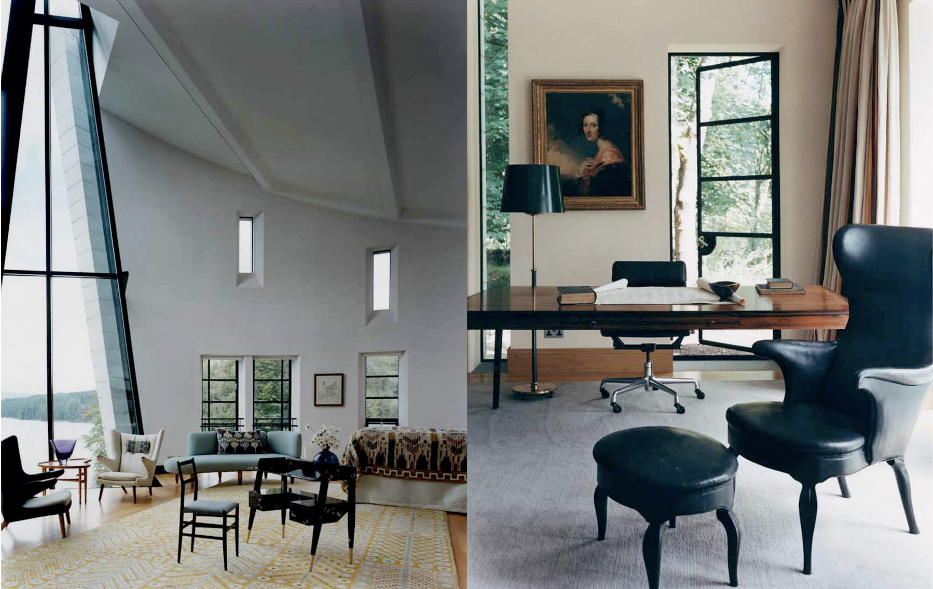
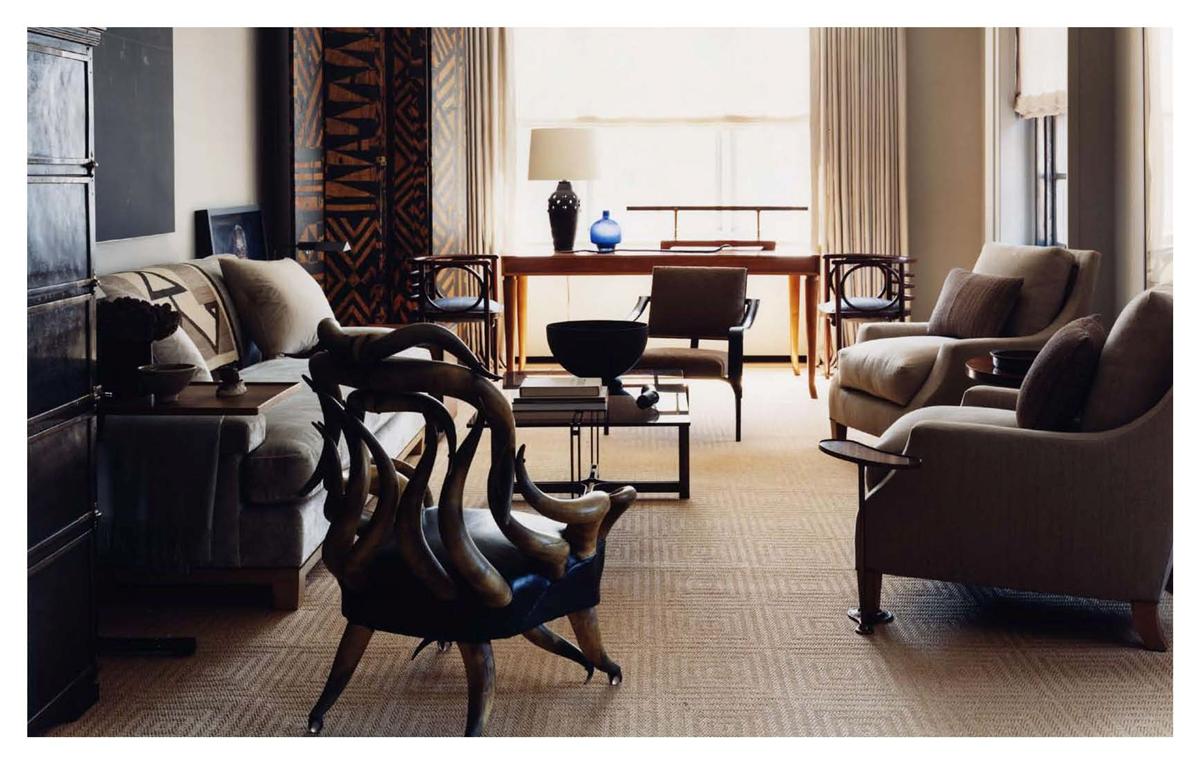
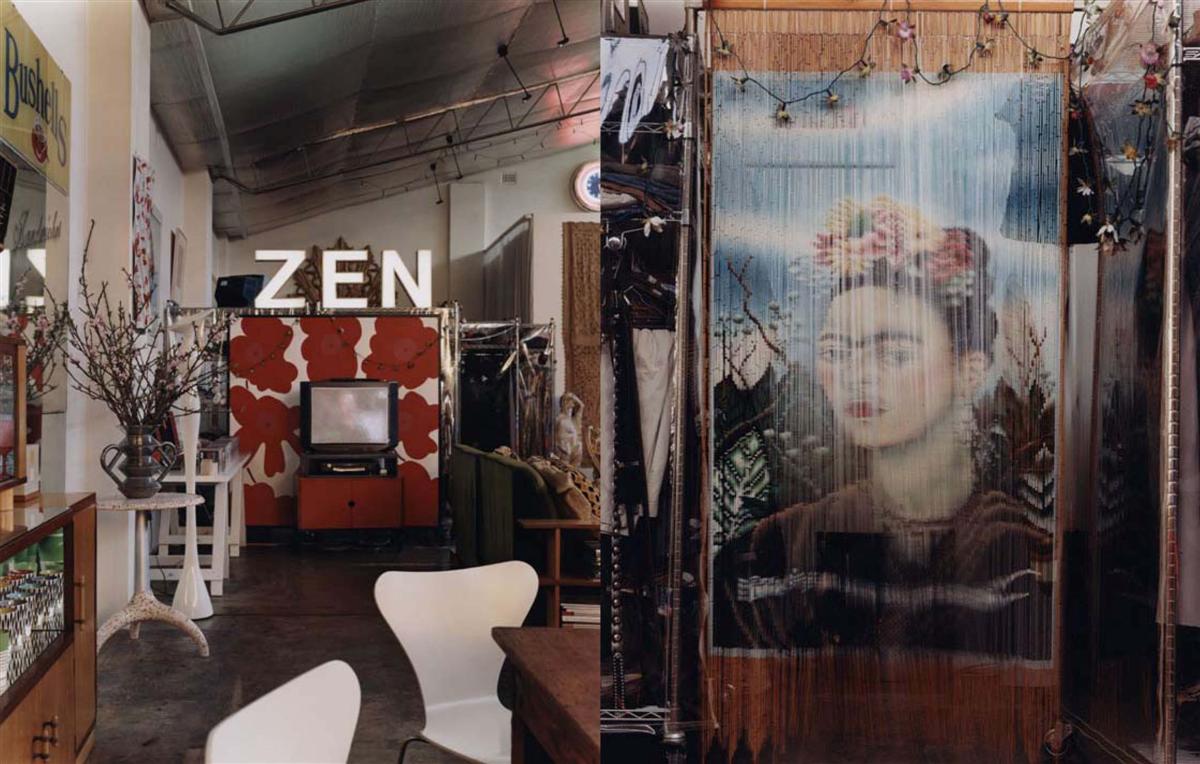
A book was born when many people had suggested that he publish a book of the interiors work he had shot for creatives the world over, then, talking one day with the co-author, Kirsten Willey, she offered to put it all together and so the book was set in motion. Here are some more great, unusual interiors.
So many great interiors. I showcased only a select few from these two books but hopefully it gave you a taste of what was to be found inside: deeply personal and memorable interiors. I’d recommend purchasing one or both of these books for when you need a bit of design inspiration that falls outside of the status quo.
Images courtesy of : Nests by Ditte Isager, Interiors by Martyn Thompson.
If you would like your home to be warm, inviting, stylish, and reflect your personal style contact us here to discuss our design services.
Ok, maybe not this cozy. (Sorry couldn’t help myself when I found this image.) But it is beginning to feel a bit chillier around here. I just saw my neighbors oak tree begin to flash its first leaves of red and orange, a sure sign that fall is just around the corner.
I am also beginning to see all of the big box stores putting out their fall colored accessories and Halloween decorations. Already? it seemed like summer would go on forever in Seattle this year. Amazing, endless days of sunshine and we Seattleites soaked up every gorgeous ray we could get.
However sweater weather is upon us and honestly fall is my favorite season. So many gorgeous colors, and the fall morning mist is something I look forward to every year.
With the fall upon us I thought I would put out a post on Mohair since it is one of the coziest fabrics I can think of and is definitely a favorite of mine whether being used in a really great sweater,
or on a sofa.
Mohair comes from the wool of Angora goats.
Both durable and resilient, mohair is notable for its high luster and sheen, which has helped give it the nickname the “Diamond Fiber”, and can be used in fiber blends to add these qualities to a textile. I have samples on my desk right now and most of them show this fabric to withstand 40-100 thousand double rubs, tough stuff. (Double rubs are a fabric test that determines how long a fabric can stand being abraded before it falls apart)
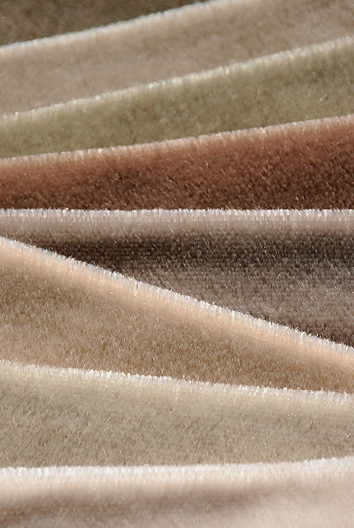
Mohair takes dye exceptionally well which is one of the reasons I love it so much. The colors you can get in Mohair are like no other fabric.
Mohair is warm in winter as it has great insulating properties, while remaining cool in summer due to its moisture wicking properties. It is naturally elastic, flame resistant, crease resistant, and does not felt. It is considered to be a luxury fiber, like cashmere, angora and silk, and is usually more expensive than most wool that comes from sheep but it will last nearly forever if treated properly.
Mohair is shorn from the goat without harming the animal. Shearing is done twice a year, in the spring and in the fall. One goat will produce 11 to 17 pounds (5–8 kg) of mohair a year. South Africa is the largest mohair producer in the world, with the majority of South African mohair being produced in the Eastern Cape. The United States is the second-largest producer, with the majority of American mohair being produced in Texas.
Mohair is also one of the oldest textile fibers in use. The Angora goat is thought to originate from the mountains of Tibet, reaching Turkey in the 16th century. However, fabric made of mohair was known in England as early as the 8th century. To get really technical on you….. The word “mohair” was adopted into English sometime before 1570 from the Arabic: مخير mukhayyar. (thanks Wikipedia)
Opuzen as seen above makes some really lovely mohairs.
I also really love the colors that Rogers and Goffigan offer in their mohairs seen above.
Schumacher has a line called San Carlo that I also really like.
All gorgeous stuff really. Can’t wait to specify some on my next project because of its beauty and durability. Hopefully we might have a yard or so left over that my client will pass on to me to use on some cozy pillows for those chilly fall days ahead.
What is it that separates an interior from being a group of items that look good together from an interior that that not only looks good but also tells a story of the inhabitants? We’ve all seen both. Where one is quite beautiful, the other you will remember forever.
A long time ago I was in New York visiting a relative. This particular Uncle had owned his beautiful brownstone close to Central Park since the 40’s. It had been filled with antiques that he had either inherited or had acquired from his neighborhood over the past 50 years. Each piece had a story and was hand picked by himself or his late wife. As he sipped his violet martini he told us tales of each piece. Some he got for a song, others he had to save up for. This made delivery day even more exciting. I remember almost every piece in that house. It was so well put together because it was their collective story. It wasn’t rushed. It was carefully thought out. Each piece placed in their home had to add to the story, like a chapter in a book.
I came across a book the other day that reminded me of this story. I was out looking for Christmas presents at the book store and I came across the book Roman and Williams, Buildings and Interiors. the first thing that caught my eye was the binding of the book itself. It had a heavy, black leather binding and raised lettering. It definitely didn’t look like the other design books with their bright front covers featuring a room with a proud designer standing perfectly poised at the side of a chair or sofa. I pulled this rather large, black book down. I started to read and was quickly reminded of how important narrative is in the design of a space.
As I read I discovered that Roman and Williams was founded by Robin Standefer and Stephen Alesch in New York City in 2002. This is how they describe their firm, taken from their website Romanandwilliams.com
“Having worked together for a decade designing sets for Hollywood films prior to establishing their firm, Standefer and Alesch have created projects that consistently find the tension between spontaneity and rigor, refinement and rebellion, and past and future. Without boundaries or borders, Roman and Williams employs a range of ideas, materials, objects, and references – from the unexpected to the pedigreed to the mundane – and, through the lens of their own singular viewpoint, create alchemy. They have an uncanny ability to mix seemingly disparate objects together in ways that “allow them to simmer to see if we can raise the temperature of a space,” as Robin and Stephen explain. “We try to communicate a voltage between time periods, cultures, and styles.” Never limited by what they designed last, the Roman and Williams aesthetic is constantly shifting and evolving, reflecting the diverse interests and profound curiosities of the firm’s principals, a practice that has earned them many devoted followers and accolades, including being honorees of the Architectural Digest Top 100 in 2023 and 2024.”
Their design aesthetic spoke to me. I glanced through briefly at first. Later, after I purchased the book, I looked at it in depth. I found myself drawn by how they work through the idea of narrative in all of their projects.
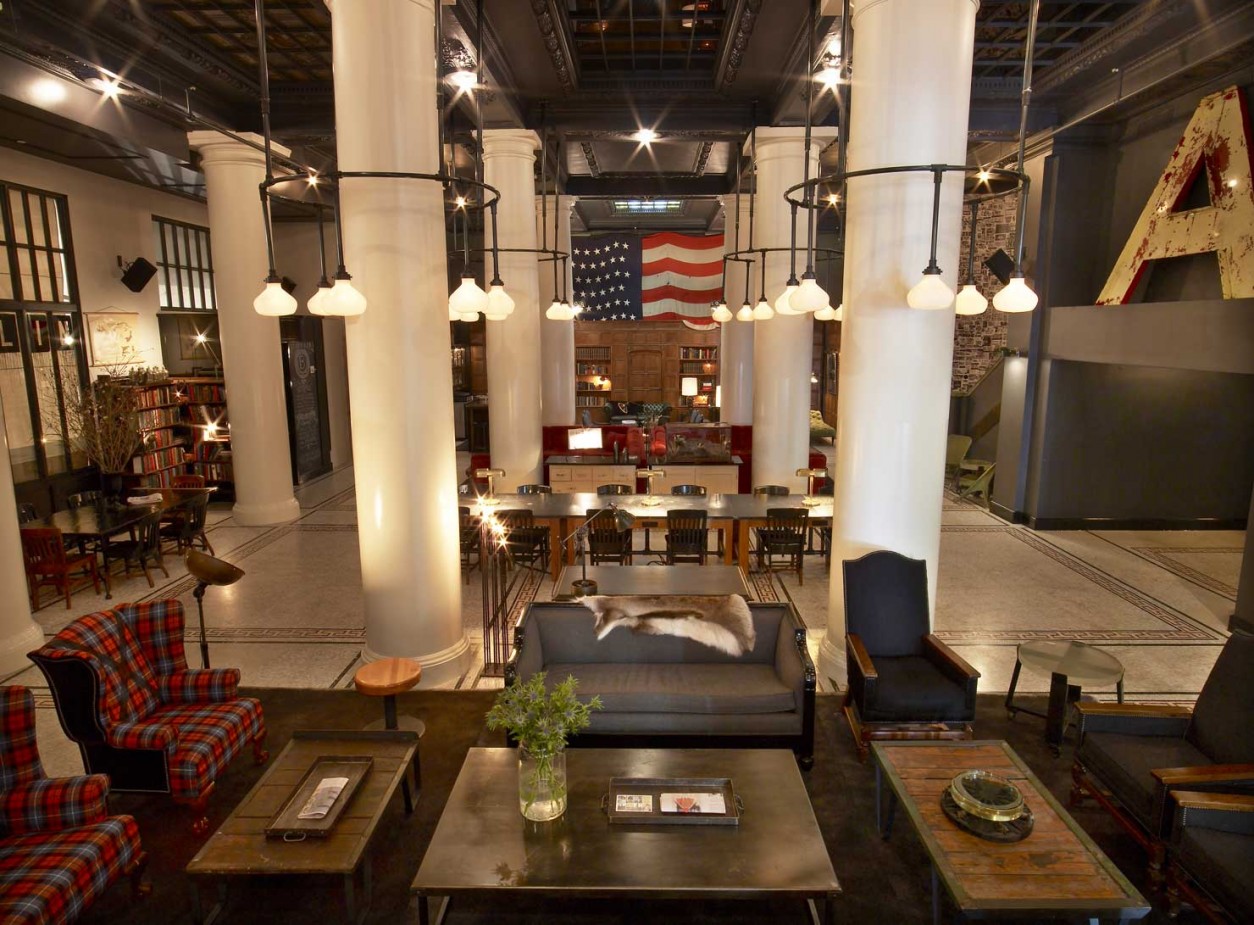
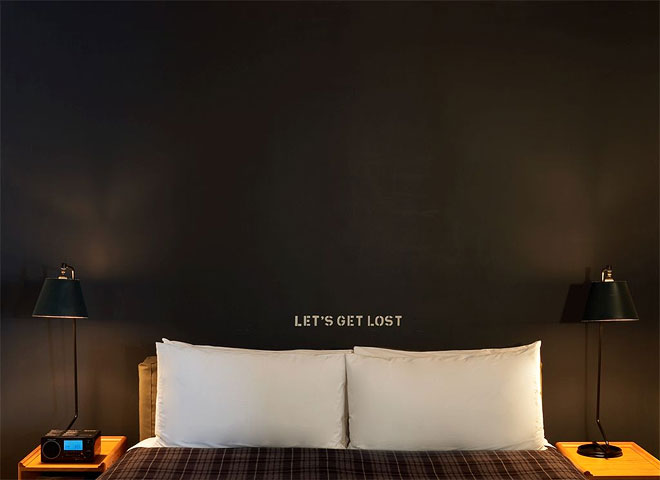
For the Ace Hotel in New York they described it as a “grand, dilapidated country house that the Doors holed up in to make a record or maybe an old money retreat where a kid threw a big party when his parents weren’t around and he and his friends trashed the place.”
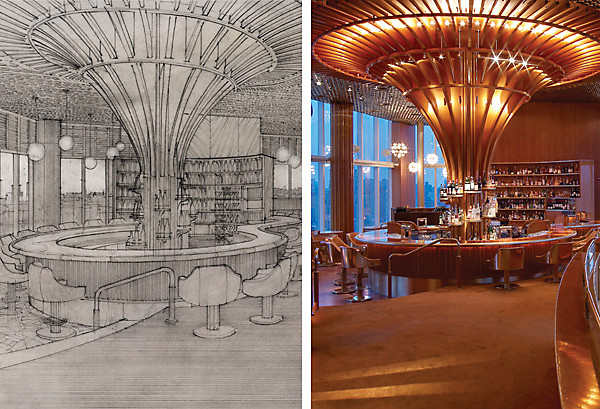
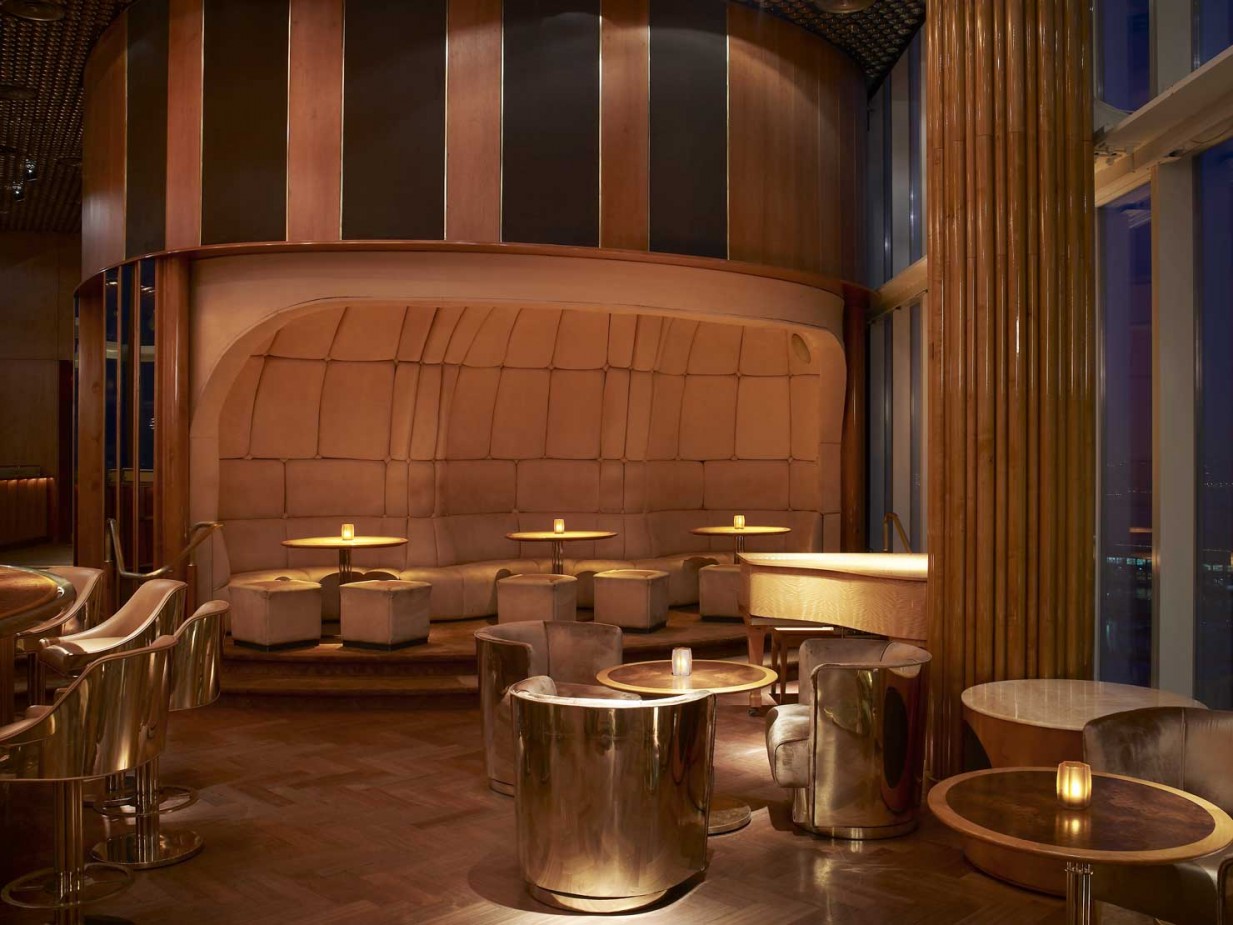
For the Boom Boom Room on the eighteen floor of the standard hotel they began with idea of it looking like a honey covered Bentley automobile. The incredible sound and privacy of being inside a luxury automobile combined with a sensual, tactile nature. Smooth, classic timelessness, and pure warm nature.
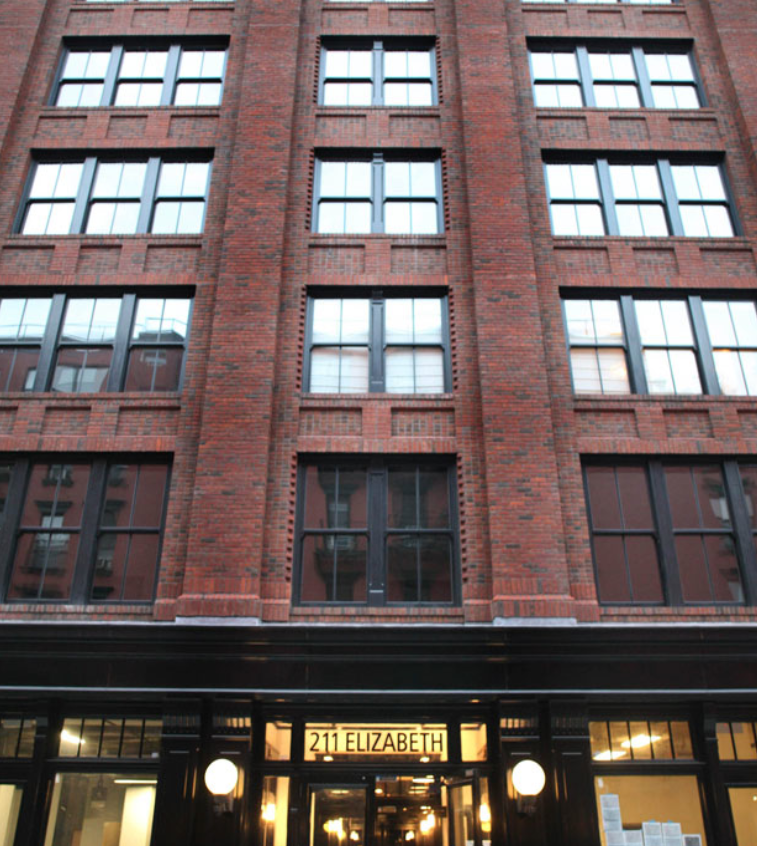
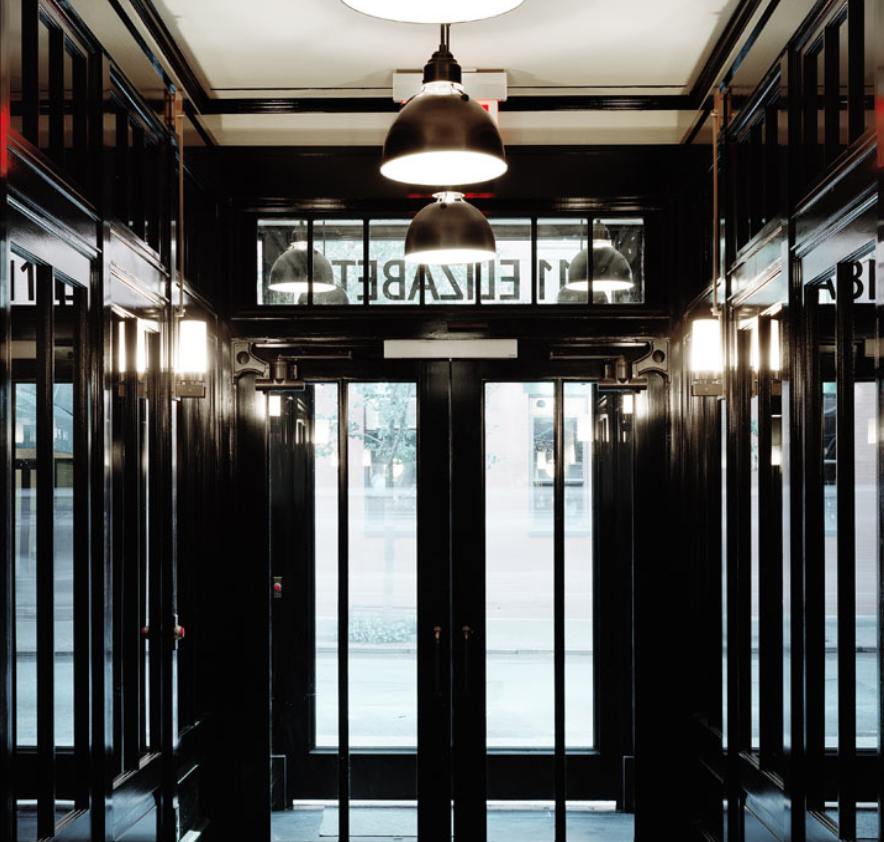
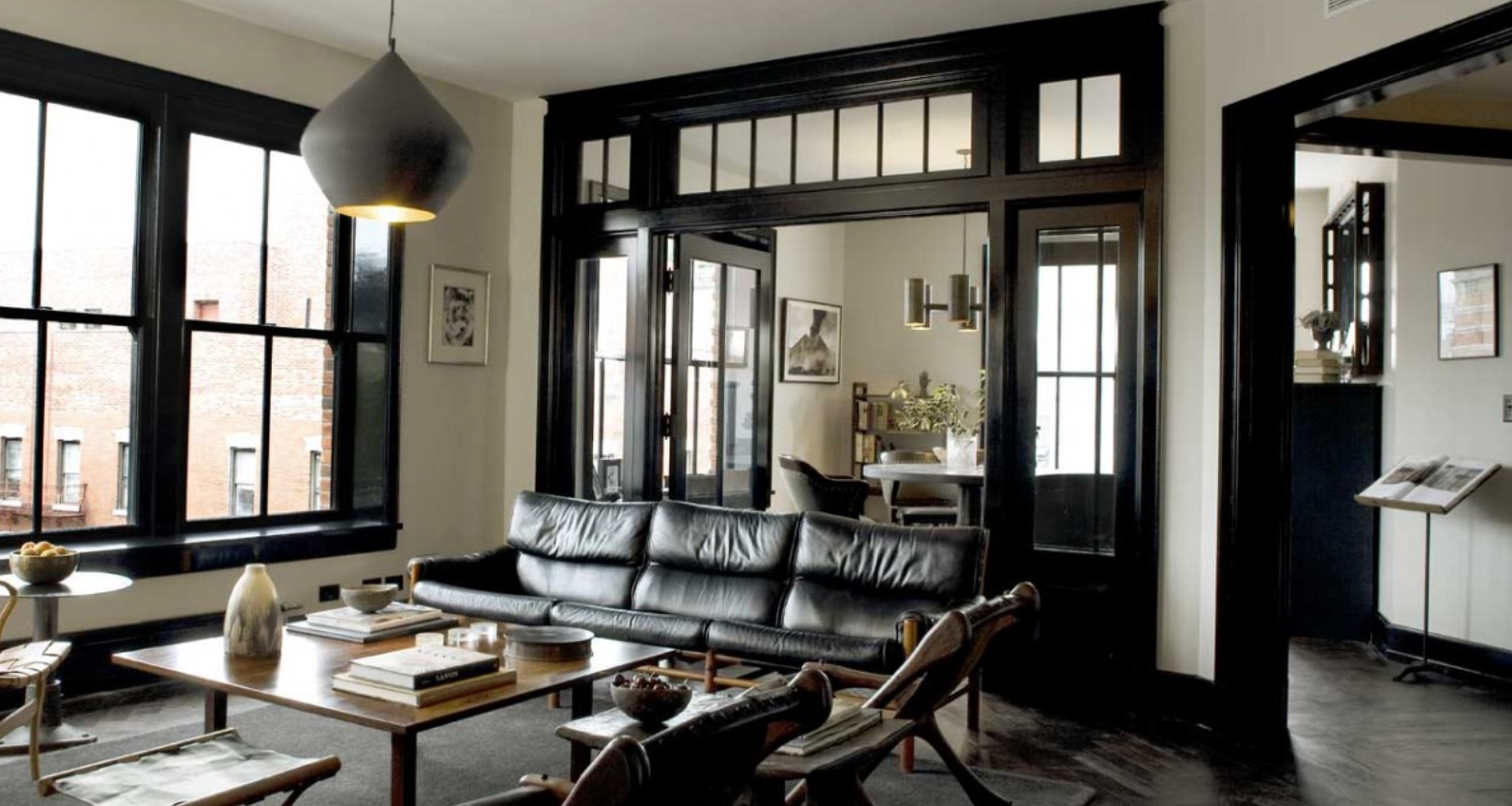
At 211 Elizabeth Street in New York their story was one of creating a classic American building that was to be like a human being. It was to have lids, lips, and eyes. It was to be a basic form and a singular experience from beginning to end. A true classic like a well made grey flannel suit.
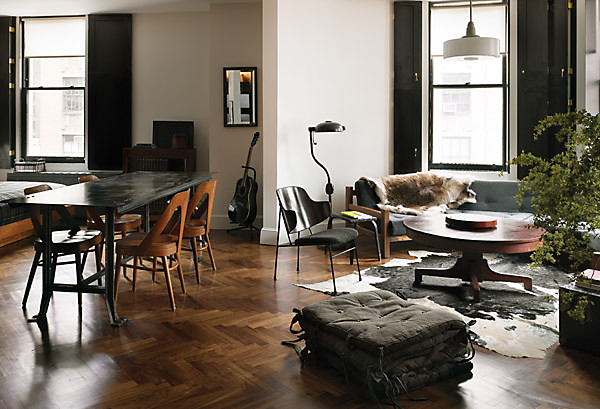
Their own home in New York is filled with the narrative of their own lives. It is filled with items they ardently collect. As they are looking for objects that reflect the stories of their clients lives, they will often find other treasures that speak to them. These objects are boxed up and shipped home from India, California, Morocco, Japan, or wherever their world search takes them.
I think the key to their success is their commitment to beauty, quality, and endurance. It is the well made chair that will be passed on to the next generation or the antique cutlery that is thick, strong, and feels great in the hand. There is a sense of memory and soul in their work and of course… the story that guides their way.
Images courtesy of wmagazine.com, Coolhunting.com, Ananasmiami.com, onekingslane.com, and romanandwilliams.com
Time…..with the long days of summer now here it feels like we have more time. The sun is up and streaming through windows, waking us up earlier and earlier. The evenings are prolonged and we can find ourselves still in the last hours of daylight at nine thirty. In short, I love it. I feel like getting all of those projects that are on my long list done. I don’t have to squeeze them into the short hours of a winter day. I can be out in the garden at 8:30 p.m., still clipping and digging or going for a walk around the neighborhood and chatting with neighbors on their front porches. An interesting by product of these slow moments is that I feel more compelled to create. Slow time can be a very good thing for refilling our creative wells. A moment to think and not necessarily DO. Simply enjoying the moment without rushing.
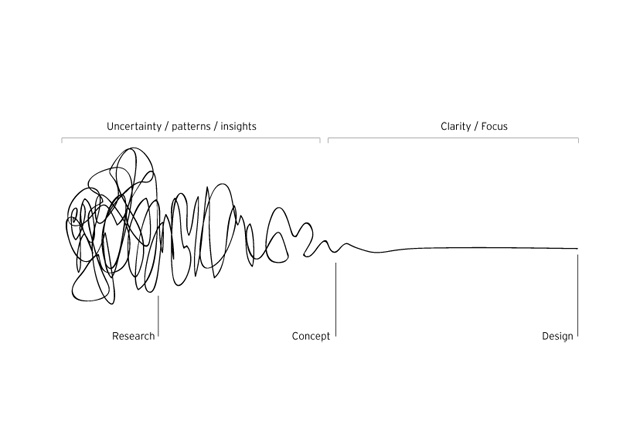
I’ve found that rushing has never helped a design project. The luxury of having more time is something that isn’t lost on me. Sometimes I wish solutions came in a straight line. But this is rarely the case. Usually it is a circuitous and tangled line. That looks something like this.
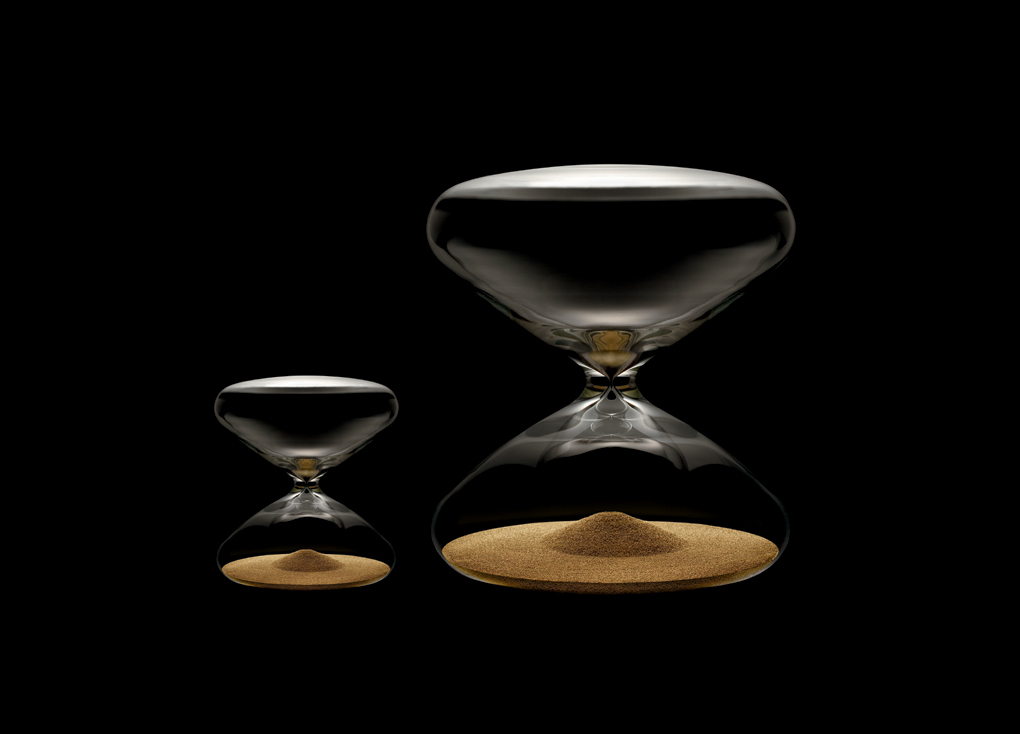
This desire for a solution to come in a straight line is usually driven by a perceived lack of time, real or imagined. However all of those paths that we take on our circuitous route are useful. They can lead us to other opportunities and other moments of learning that we can use later. Let’s take this journal entry for example. I was first reading a book about the history of knot tying. I was thinking about how long it must take to perfect this art and how many mistakes you had to make to get to a perfectly constructed ocean plait knot. It is a slow process of learning. Trial and error. This then reminded me of a great book I have called 101 Things I Learned in Architecture School by Mathew Frederick. Looking through it I found on page 81 the quote I was looking for. “Engage the design process with patience. Don’t imitate popular portrayals of the creative process as depending on a singular, pell-mell rush of inspiration. Don’t try to solve a complex building in one sitting or one week. Accept uncertainty. Recognize as normal the feeling of lostness that attends to much of the process. Don’t seek to relieve your anxiety by marrying yourself prematurely to a design solution; design divorces are never pretty.” Words to live by. I then started to think about how to time oneself in such a manner that would simultaneously keep you on track and yet move at a pace that encouraged you to ponder. I thought about an hourglass and then started to look for images of one. On Google I found a reference to Marc Newson and his work with Ikepod which is a timepiece company. He has created a line of very high end hourglasses that are amazing.
These are the type of products that are not created “pell-mell” but thoughtfully developed and created. You can see the video by clicking the link below.
After watching this I realized that I had a journal entry. I didn’t sit down and decide that I needed to write about time. I was wandering down a path, taking time out of a weekend day and had encountered a series of experiences that I realized were connected. I wasn’t married to any particular outcome.
Sometimes being creative means not knowing where you are going down the path but taking the TIME and wandering just the same. Looking for and finding the connections along the way.
Images courtesy of legitlifestyle.com, marc-newson.com, the jewelryeditor.com
I love art. When I was in High School, I had a great art teacher. She was great because she gave us space to create and she opened the doors of possibility. She gave us just enough information to intrigue our imaginations and then showed us the tools. She also showed us images of the work of other artists and how they were using the medium. At first you copied the work and then as you worked through it you began to find your own voice in the work. While I don’t profess to be a hyperrealist, I do enjoy doing my work whether it is in pencil, watercolor, silver, wood, or on the potters wheel. There is just something about losing yourself and having time slip away in the creative process. I have these same feelings when I’m working on an interior design project. You have a bit of information from the client and you then begin the process of creating a space that speaks to who they are. Your tools are your pencil, the layout, the pieces of furniture, artwork, colors, textures, materials, light etc. It all begins to come together into a finished piece.
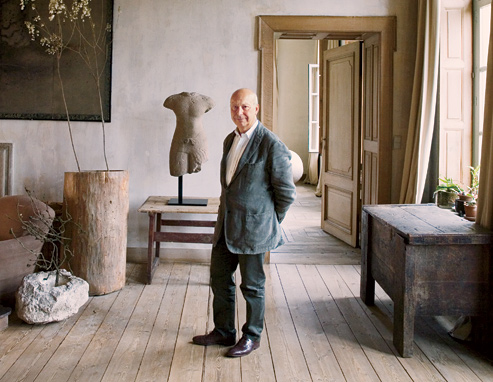
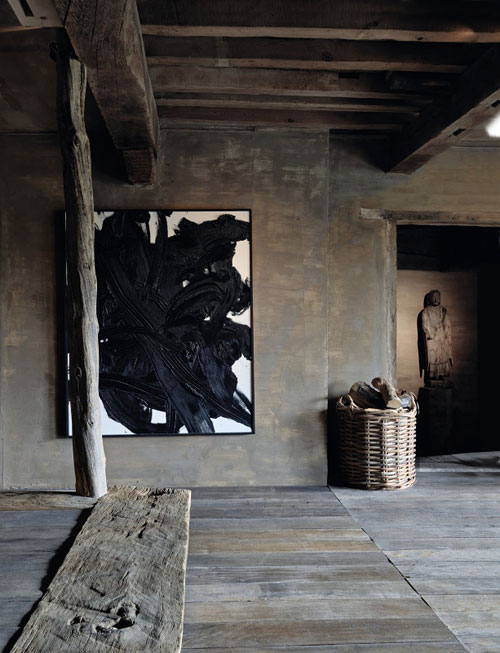
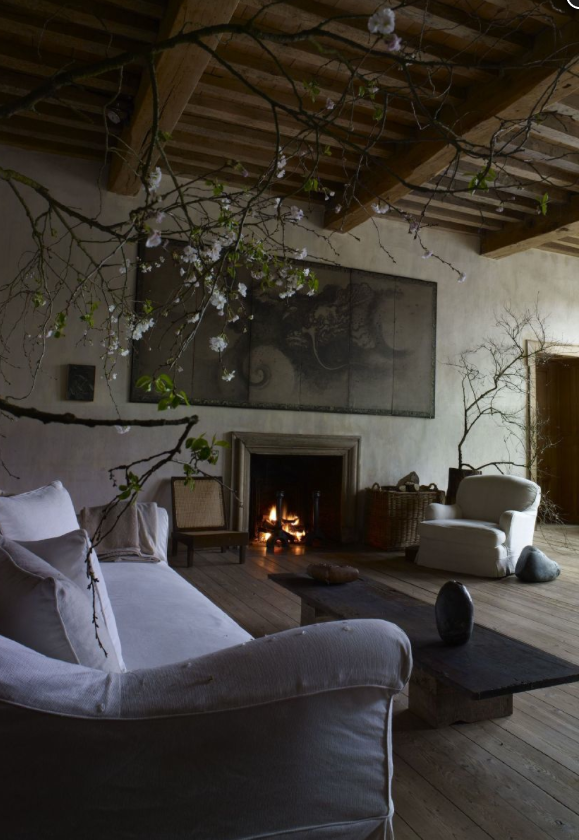
When I first started doing design, just as in High School, I looked at work that others were doing. One of my favorites was Axel Vervoordt. He is an antiques dealer, curator and interior designer who’s work is shown in the image above and below. He is from Antwerp, Belgium and has been an influential taste maker. His clients range from royalty to rock stars. They are drawn to the Belgian antiquaire’s cerebral good taste. One of the proponents of the WABI SABI movement he has a way of mixing antiques with contemporary art. I’ve admired his work for some time with its simplicity, rawness and penchant for the artful interior.
Another design team I have admired is Anne Marie Midi and Jorge Almada known as Casa Midi. They are based out of Bruxelles, Belgium and San Miguel de Allende Mexico. As you can see in the work below they have a way of mixing the old with the new, the artisanal with the found object d’art.
There are many others who’s work I’ve admired over the years and this post could go on forever showing examples of the spaces they have created but the point is that I’ve watched the way these designers have handled space and I’ve taken lessons from their usage of art in their work.
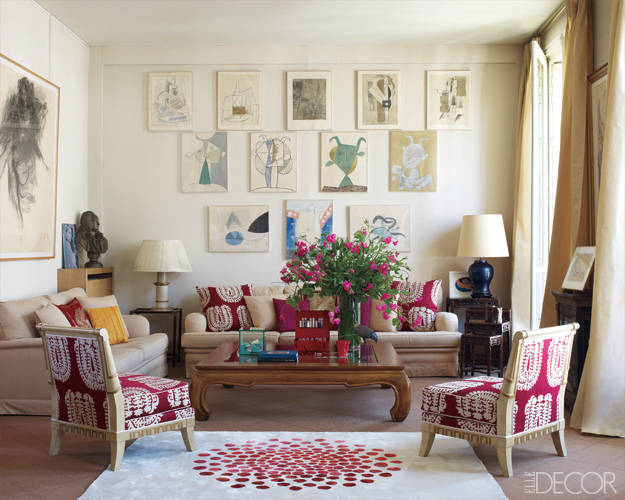
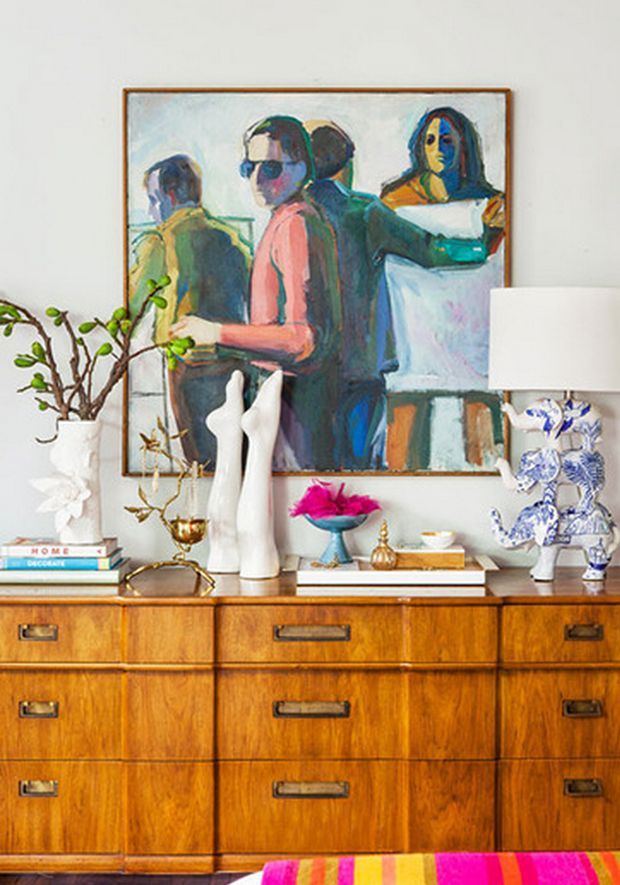
For example imagine what the room below by Sabine De Gunzberg would look like without all of that artwork. It is the cool greens and blues that play the foil to those popping fuchsias in the chairs and rug.
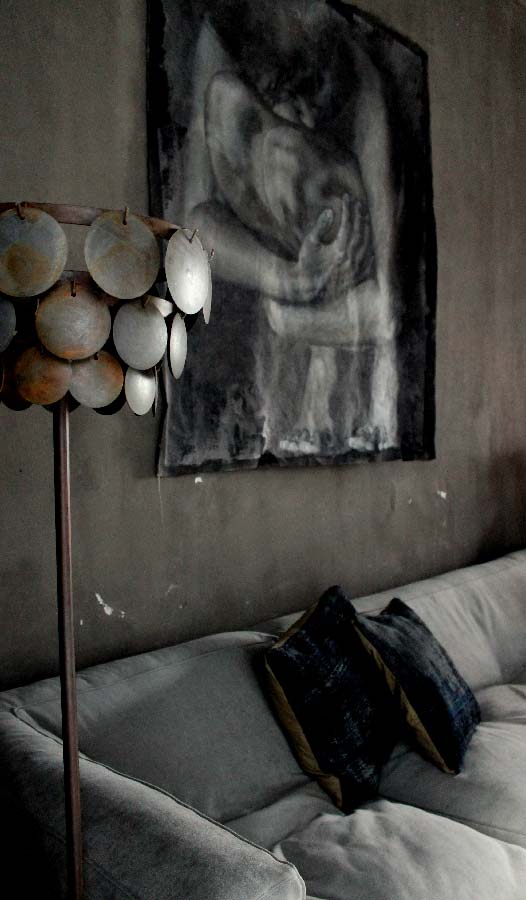
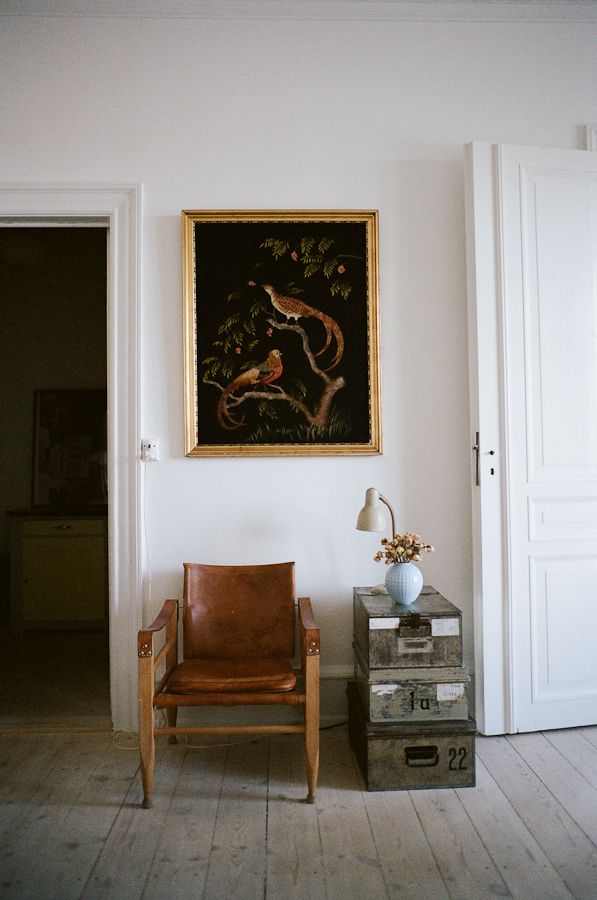
Or sometimes a piece of artwork can perfectly mirror the mood of the room. It can be the cornerstone piece that inspires an entire space. Dark, smokey, moody like the image below.
Maybe its something bright and balanced that perfectly creates a vignette of the owners lives and the objects they have collected along the way.
At the end of the day what is most important to me in my work is that every piece, I consider placing in a room is part of an overall story. The story that the client has told me. That each piece is considered a part of the canvas. Individual strokes of a brush that create a picture of their lives.
Images courtesy of Grahamandco.org, axel-vervoordt.com, elledecor.com, hickoryhill.tumblr.com, kinfolk.com
“Just how much do you charge for your services?” a question that is always asked and is sometimes quite difficult to answer. Why? Because it depends on the level of service that a client wants. Once that is defined then the answer becomes quite clear. I came across an article the other day by another designer on this very subject and it was so good that I thought I would repost it here. Forgive me if this is a bit of a business related post but I’ll add in my take on it as well at the end. It was written by Linda Merrill who is the founder of the interior design company, Decorative Surroundings in Boston, MA.
Here is her article
Several years ago, at an architecture trade show in Boston, I attended a panel discussion on how to price design services. I was new in business and assumed that most of the other attendees would also be business “newbies”. I was surprised, shocked even, when the audience was asked by a show of hands how long they’d been in business. While at least half the attendees were new business owners, the rest had been in business over five years and some had been around for over twenty years. It was a real eye-opener and I realized that no matter how long one has been in business, pricing one’s services is complex and always in need of evaluation. Given the complexity of the issue for professional architects and designers, it’s no wonder that those seeking design services are nearly always confused about the issue. Let’s face it, we don’t know what we don’t know and we all make assumptions based on limited knowledge.
The single most asked question made to a designer is: “What will this cost me?” And most designers will put off the answer until they know more about the entire scope of the project, the clients and what is involved. It’s no wonder there is confusion and, at times, suspicion about the process.
There are some basic ways that the majority of interior designers and decorators charge for their services:
1.Hourly rate for each and every moment spent working on the project: This includes all meetings, telephone calls, emails, shopping, designing/drafting, buying, installations and logistics. The hourly rate itself varies by geographic region and experience/professional standing of the designer, but roughly it’s between $125-$250 per hour. Larger firms will have tiered structures based on who in the firm is working on the project (assistant designers vs. the owner, for instance) and one-person shops will generally have a single established hourly rate. Clients pay direct to retail stores and hire their own contractors: Clients can control the total dollars spent to the extent that they are responsive to the designer’s queries and quick to make decisions, and do the legwork of ordering retail products and receiving shipments themselves.
2.Hourly PLUS markup on goods: Includes all of the above, plus a markup on custom and trade-only merchandise, and a percentage on any retail purchases made by the designer on the client’s behalf. This additional markup covers the design firm’s time and expenses of managing all the ordering, logistics, trouble-shooting, delivery and installation of the merchandise. If the client wishes for a turn-key level of service where their only job is to approve and pay for the design, this is the type of plan they will be looking at.
3.Flat fee rate: For obvious reasons, a flat fee has both positive and negative aspects to it. For the clients, they sign the contract knowing exactly what they will be paying their designer and there should be no surprises. For the designer, they can establish a specific payment structure to cover costs and provide income at regular intervals. The downside for both client and designer is that the entire plan needs to be clearly understood at the outset. Any changes or additions to the original plan may require a renegotiation of the contract. Designer’s fear that a flat rate means the client will lose respect for their time and waste it because they aren’t paying by the hour. A project estimated to take 100 hours that suddenly takes nearly 200 means a big financial loss for a designer. On the other hand, clients fear the designer will pad their time in order to charge more.
4.Percentage of the entire budget: This means that every dollar spent on a project is tallied up at the end and the designer receives a percentage, which is usually in the 15-30% range. A budget is established from the start and payments are made based on the estimated total budget and then by the end of the project, the total expenditures are added up to be sure the designer has received the agreed upon percentage. For the most part, the flat fee rate (#3 above) is calculated using this same equation, but is capped, whereas the percentage system is not capped.
As you can see, “What will this cost me?” is not an easy question to answer! In fact, it’s not THE question to be asking. The actual question should be “How do you bill for your services?” allowing the designer to describe their scope of services and how they bill for them. The client needs to provide specific details with regards to their budget and exactly what type of service they are looking for. Unless a designer charges a simple flat fee to provide a design plan for a space, with no added procurement services offered and little alterations to the plan, they will simply not be able to give a price without knowing the budget and scope of the project because the ranges are too varied.
A furnished living room can be $10,000 or $100,000 and more – depending on what the client wants. The budget is always in the client’s control and ultimately the designer can either accept the job within the stated budget, or will choose not to. Contrary to popular belief, designers are not looking to simply spend as much of the client’s money as we can. We want to provide the right services for the clients needs and to be fairly compensated for our efforts and experience.
1) You want a designer to create a vision and design plan only: You will be doing all the legwork, hiring and managing contractors, ordering furniture and dealing with all the logistics and trouble shooting as needed. You are willing to put in the work involved so that as many of your dollars as possible go towards the actual decoration of your space.
2) In addition to a design plan, you want a full-scale, turn-key project where you only want to have to speak with the design firm and they will deal with all other parties involved: Additionally, the majority of the purchases are delivered and installed on a single installation day (aka “the reveal”) versus piece-by-piece deliveries. This level of service includes additional charges for insured warehousing, and two sets of delivery charges – one to deliver and inspect furnishings at the warehouse and another to then re-deliver to the home.
3) Some negotiated combination of the above.
As with everything else, we pay for things with time or money and this is certainly true when it comes to interior design services. -Linda Merrill
Linda did a great job of breaking the fee structures down. It all comes down to understanding what expectation the client has. It also involves clearly defining for them how to achieve that and what that will cost. Sometimes it can mean re-defining their expectations. Doing this can mean all the difference in the world between having a happy client and one that is displeased. People in this business are usually “PLEASERS”. Most of us want nothing more than at the end of the project for the client to be really excited about their home and pleased with all of the work that we have done to make their dreams a reality.
In my own business I have found that what works best is to work on a scaled hourly wage. There is design time, drafting and meeting time, and administrative time (where project purchasing and management occurs). I then purchase goods on the clients behalf and we price it at the suggested retail price. So the client pays the same amount whether they were purchasing it or we are. However, it benefits the client to use my expertise and resources to purchase for them. I have the experience to know all of the issues that can come about in purchasing from the myriad of vendors out there and we know how to deal with issues when they arise. It also allows me to have control over delivery times and thus timelines on a job.
I’ve heard of other designers who are also offering design services in a type of “design in a box” format. This is where the client pays a scaled flat fee for a type of room in their home and then they are responsible for sending the designer a measured plan and elevations of the room with pictures of the furniture they would like to keep and a few images of rooms that they like. The designer then puts together a concept board and shopping list for the client to handle on their own. I haven’t tried this yet and I feel a bit hesitant about offering it because this is such a personal business. I like to get to know my clients and find out what interests they have and what would really make their home special. Finding out that they have an amazing collection of photographs or that they have strong familial tie to a certain country or place, for example can mean all the difference in the design of a room that really speaks to them. Remember what I said about “Pleasers”. I want their home to be a reflection of who they are and what they do or have strong ties to, as well as it being really beautiful.
Let me know what you think?? Has anyone used this type of service before and what was your experience with it? I always try to keep an open mind especially as I’m growing my business.
So as you can see the veil is transparent as long as I am asking the client all of the right questions to begin with and I’ve given them the answer that addresses all of their needs.
Images courtesy of dphotograper.co,uk, Vangelis Thomaidis/sxc.hu, fiumaf.com, cococozy.com, subversivecopyeditor.com
If you would like your home to be warm, inviting, stylish, and reflect your personal style contact us here to discuss our design services.
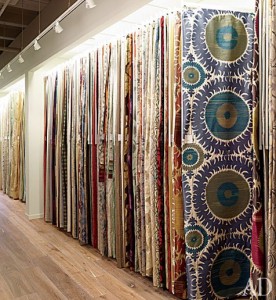
I frequently find myself surrounded by piles of beautiful fabrics. Mind you they are usually just small 6″ x 6″ square samples of a fabric but nonetheless, they are one of the biggest pieces of the design puzzle. Finding just the right fabric can sometimes bring an entire room together. I remember when I was in school we spent hours studying line, form, building code, auto cad, etc. but fabric was but a small portion of the program that I was in. It was usually only at the very end of a semester that we would quickly pull a few fabrics together to present along with the rest of the architecture that we had been slaving over.
But I have always had a particular weakness for fabrics, see my earlier post on Linen. I had learned quite a bit about linen and about textiles in general from one of my first jobs out of college. I was working for a woman who had just started her company importing Italian and Portuguese textiles. She was a great designer and looking back now I realize how much that experience was a seed for the career I have now.
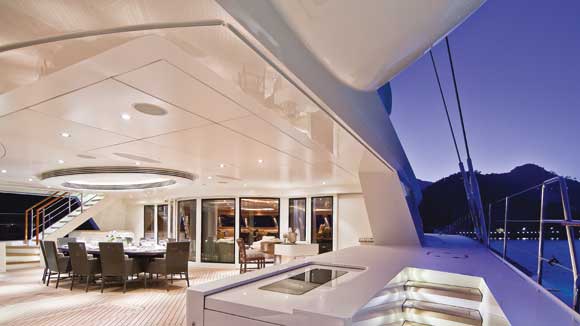
It wasn’t until I worked for a local high end residential firm here in Seattle that I discovered “fabric”. I had the unique opportunity to be assigned to specifying an entire ship. It was being re-done with nearly all of the fabrics being replaced. It was basically like doing a hotel, except every room was different. Each room had to be luxurious, comfortable, and able to withstand multiple guests and deal with extra harsh conditions at sea such as salt water air, and bright sun. The image below isn’t the boat I worked on but was similar in style. Our client was very private so no pictures were allowed.
I started from the top deck and worked my way down to the underwater lounge. There were fabrics for pillows, sofas, chairs, window coverings, bedding, ceiling panels and built ins. There were also some new furniture pieces to be specified but the majority of my work was to come up with the fabric themes for each of the rooms. I would work through a floor and then present to my boss for review. Sometimes I was on the money, sometimes I had to replace a fabric or two. Sometimes I had to go back and re-work it all. (Wait a second, no one told me he hated green.) But frustration aside, it was a great experience and I really honed my eye.
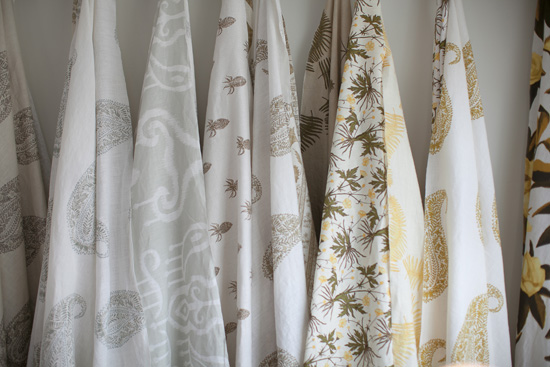
Now that I have my own firm, I still find myself going through wing after wing at the design center, except now its my design, for my client that I’m trying to find that really special fabric for. I can have a very specific idea in my head about what I am looking for and sometimes I can’t seem to find it. This frustration led me to wondering about designing my own fabric line.
There are some other women in the industry that by watching their progress have shown me what a small fabric line can look like. People like Lauren Liess out of Virginia.
Victoria Larson in Annapolis
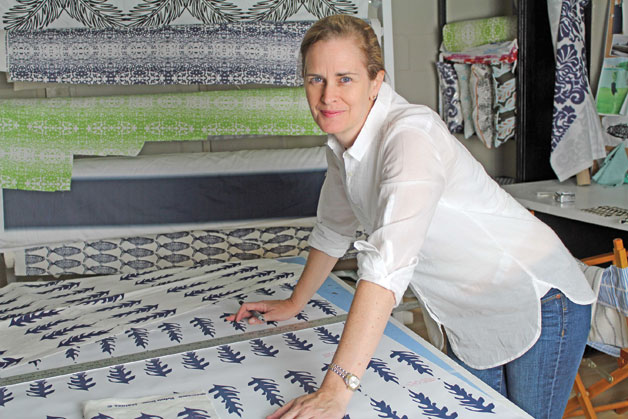
Locally we have Kassana Holden, from Vashon Island who not only does the designs for her fabrics she also prints them right there in her studio using her wide format Epson printer.
Watching their progress has started me on a journey. Not exactly sure where I will end up with this but I’ve got a big stack of books on textile design, and I’ve been combing the internet looking for ways to get my designs printed on the types of fabrics I love. I’ve already found out so much. Everything from resist-dyed silk satin damask (rinzu), embroidered with silk and metallic thread as you see in the image I posted at the very top.
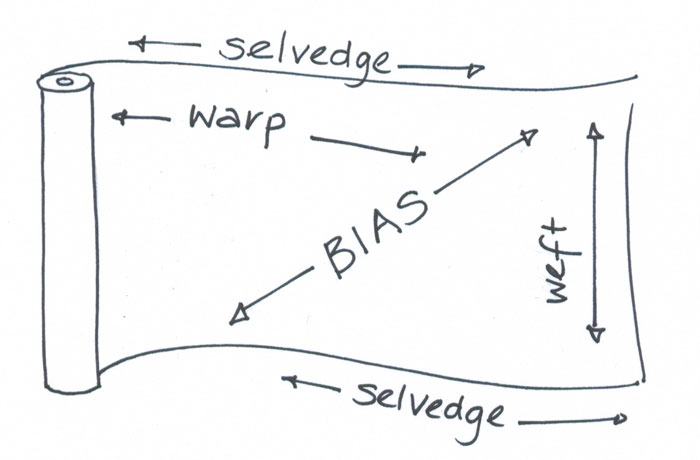
To the basics of fabric design like what warp, weft, selvedge, and bias mean. I’ll keep you posted as I move forward and look forward to your feed back as I get ready to select my own designs.











 On the another side of the world is the






















 Holland Stephens Interiors